

Your Instagram Comments Are Telling You What to Sell Next
Your customers may already be telling you what they want next. They are just not filling out a product survey.
They're commenting: “Do you have this in black?”, “Can you make a smaller version?”, “I wish this came in a bundle”, and “Will you launch this in my size?”
These comments can look like ordinary engagement. But when the same questions and requests appear repeatedly, they can reveal something much more valuable: what your customers actually want to buy.
Your Instagram comment section can become an informal, always-on source of customer research. Instead of only measuring comments by volume, businesses can look at what those comments are saying—and use those insights to improve products, create new offers, and identify unmet demand.
Your Comment Section Is More Than an Engagement Metric
Most brands look at Instagram comments and ask: “How many comments did this post get?” Try asking a second question: “What are people asking for?”
Imagine a clothing brand repeatedly receives questions about XL sizing, other colors, petite fits, matching pants, or a winter version. These aren't random comments. They're signals.
One person asking for a product variation doesn't necessarily indicate demand. But when the same request appears across multiple posts and from different customers, a pattern starts to emerge.
Patterns are where useful product insights begin.
5 Types of Comments That Can Reveal Product Opportunities
The most obvious signals are direct product requests: a new color, travel-size version, larger size, format, or other variation. You don't need to act on every request; look for the ones that appear repeatedly.
Feature requests tell you how customers would improve something you already sell. Requests for a pump, carrying case, or more storage can reveal what would make the current product more useful—or differentiate a future version.
Complaints can reveal unmet needs as well as service problems. “I love this, but it's too bulky for travel” may point toward a travel-friendly version, while a request for a cheaper option may suggest a smaller or entry-level product.
Questions about products you don't sell can suggest product extensions, bundles, partnerships, cross-selling opportunities, or new categories. Repeated sunscreen, bag, or coffee-machine questions may show where customers want the brand to go next.
Availability questions can reveal where demand is coming from. Repeated questions about delivery to a city, country, or international market tell you not only what customers want, but where they want it.
- Product requests: New colors, sizes, formats, and variations
- Feature requests: Improvements that make an existing product more useful
- Complaints: The unmet need underneath a customer's frustration
- Products you don't sell: Extensions, bundles, partnerships, and new categories
- Availability questions: Cities and markets where customer demand is emerging
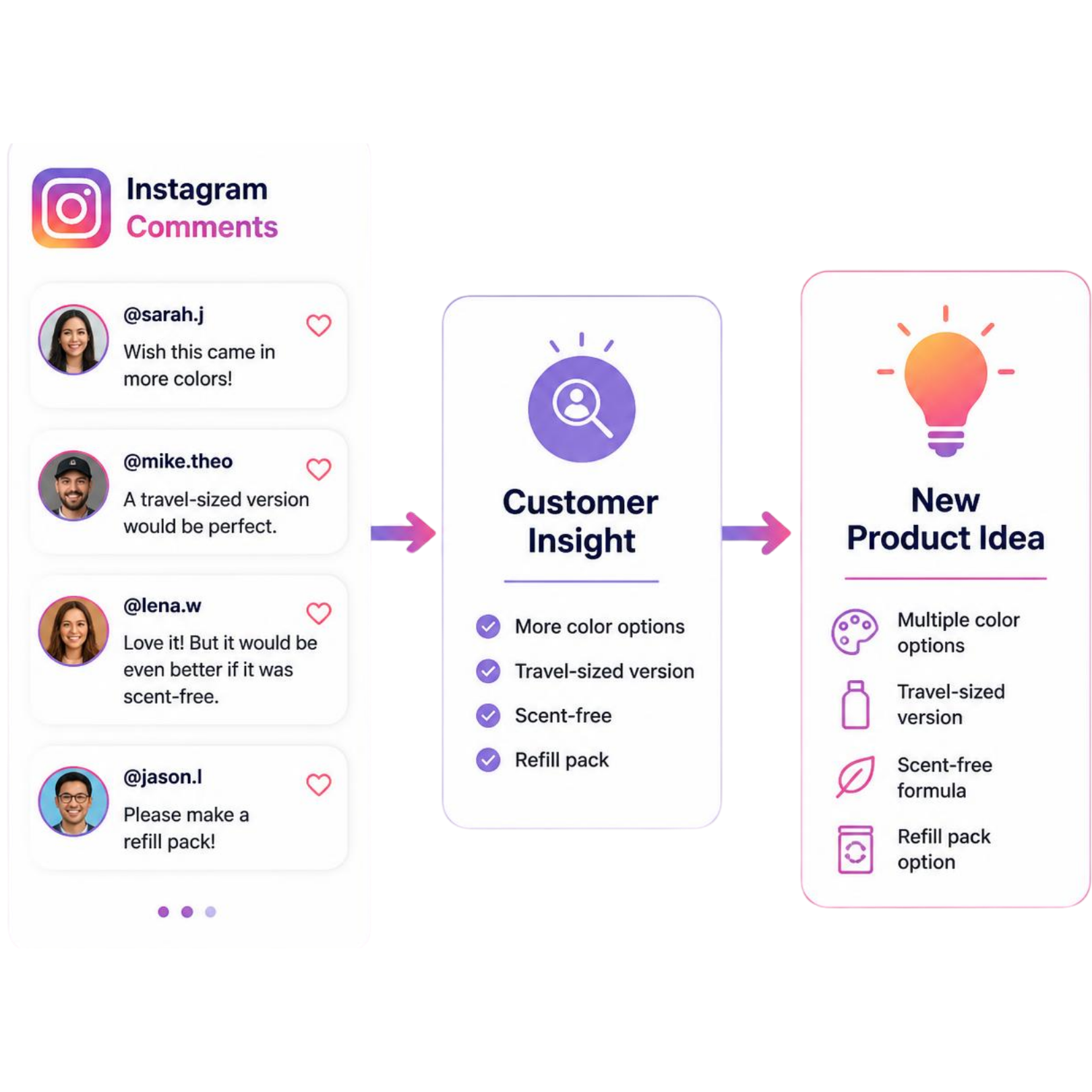
One Comment Is a Question. A Pattern Is Data.
Don't treat every comment as proof that you need to build something. Instead, look for repetition.
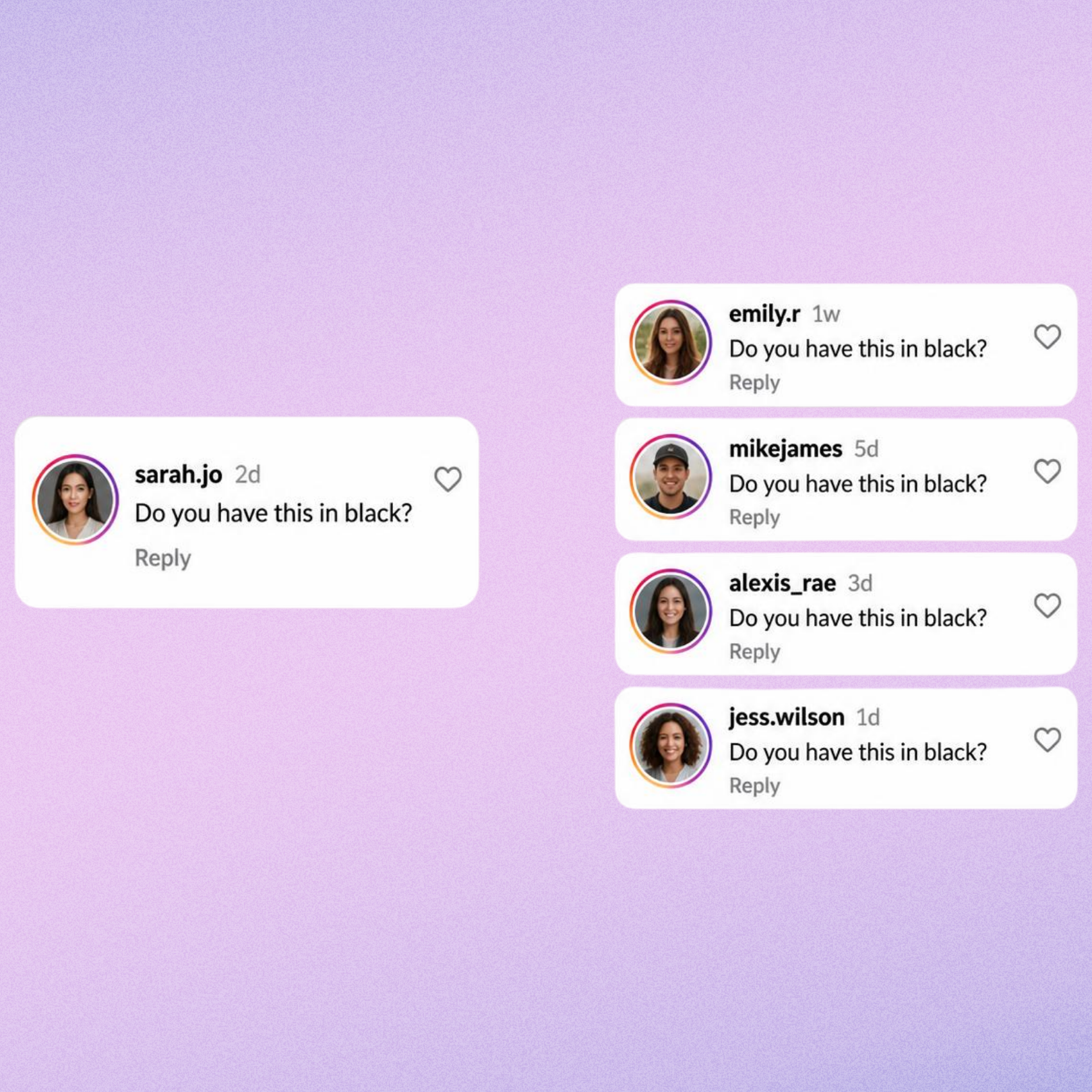
If customers ask for a black version on Monday, Wednesday, Friday, and again the following week, that is no longer one person's preference. It is a recurring signal.
The more frequently a request appears across different posts and customers, the more attention it deserves. Track themes such as colors, sizes, features, bundles, pricing, shipping, and new products.
Over time, those themes show you what your audience repeatedly asks for.
- Colors
- Sizes
- Features
- Bundles
- Pricing
- Shipping
- New products
Turn Instagram Comments Into a Simple Product Research System
You don't need a complicated research process. Start with four steps.
Collect comments containing requests, questions, complaints, and suggestions. Categorize them into product, feature, pricing, size, availability, or shipping themes.
Identify patterns that appear across different posts, then validate the strongest ideas before building anything. Use an Instagram Story poll, ask the audience directly, create a waitlist, or launch a limited version.
The process becomes Comment → Pattern → Hypothesis → Validation → Product. That is much smarter than building a product based on one enthusiastic comment.
- Step 1 — Collect: Save requests, questions, complaints, and suggestions
- Step 2 — Categorize: Group comments into meaningful customer themes
- Step 3 — Identify Patterns: Find recurring requests across posts and customers
- Step 4 — Validate: Test demand before committing to a full product launch
Use Automation to Spot Patterns at Scale
This becomes harder as your Instagram audience grows. If you're receiving 50 comments a day, manual review may be manageable. If you're receiving thousands, valuable patterns can easily get buried.
Flozari features such as Sentiment Analyzer, Keyword Targeting, Comment Auto-Reply, and Activity Analytics can help businesses manage and understand large volumes of Instagram interactions.
Recurring keywords around size, price, bundle, custom, available, and shipping can highlight the topics customers care about most.
The goal isn't simply to automate replies. It is to make the conversations happening around your content easier to understand and act on.
Imagine Your Comment Section as a Product Dashboard
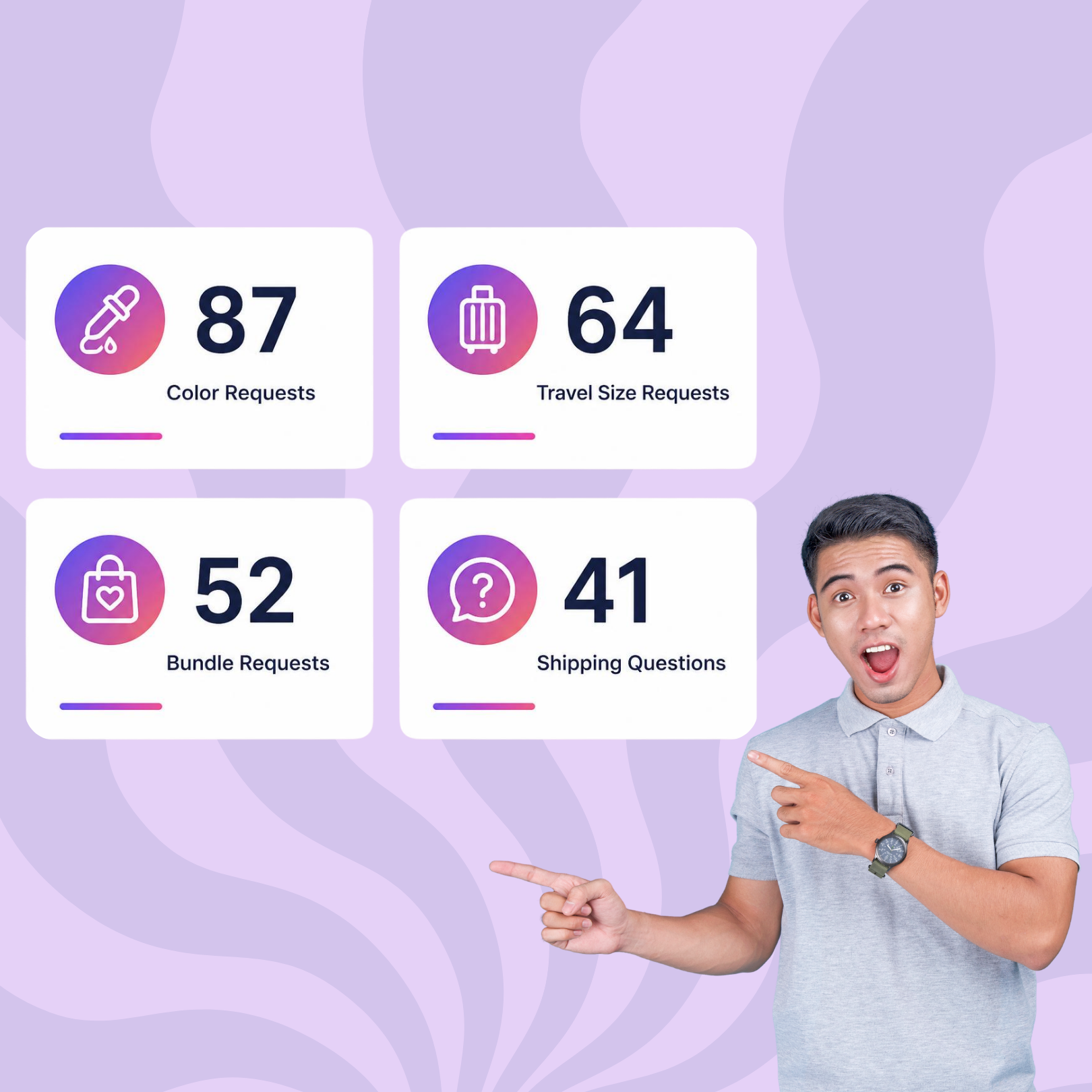
Instead of seeing 1,000 comments, imagine seeing 87 requests for a new color, 64 requests for a travel size, 52 requests for bundles, 41 questions about international shipping, and 38 requests for a larger size.
Now the comment section looks less like a social media metric and more like a customer-insight dashboard.
It doesn't replace proper market research. But it gives you something extremely valuable: real customer language from people already interested in your brand.
- 87 color requests
- 64 travel-size requests
- 52 bundle requests
- 41 shipping questions
- 38 larger-size requests
Validate Before You Build
A comment is a signal—not proof of demand. If customers repeatedly ask for a new color, test the idea before committing to it.
Post “Would you buy this in black?” and use a simple poll: YES — Absolutely or NO — Keep the original.
If the response is strong, create a waitlist or limited launch. Now you have moved from “People are asking for it” to “People have shown they're interested in buying it.”
That is a much stronger foundation for a product decision.
Your Audience Can Become Part of Your Product Team
Customers constantly tell you what they like, dislike, find missing or confusing, would change, want next, and where they want to buy.
Instead of seeing “Do you have this in blue?” as another comment to answer, consider whether it is also a product insight. Instead of dismissing a bundle request as casual feedback, consider whether it points to a new offer.
Your comment section can become an ongoing feedback loop between your brand and its customers. You simply need to start listening differently.
- What customers like
- What they dislike
- What's missing or confusing
- What they would change
- What they want next
- Where they want to buy
Final Takeaway
Your customers are already telling you what they want. They're just telling you in the language they naturally use—through comments, questions, requests, and feedback.
Don't measure Instagram comments only by how many you receive. Pay attention to what they're saying.
One comment is feedback. A recurring pattern is insight. And the right insight could become your next product, feature, bundle, or revenue opportunity.
Your next best-selling idea might already be sitting in your comment section. You just have to listen.
Listen for the pattern.
Turn recurring Instagram questions into customer insights your team can act on.
Understand your commentsContinue reading
More Instagram automation guides

6 min read
The 5-Minute Rule: Why Fast Instagram Replies Can Change Your Sales
Read article
6 min read
The Death of the ‘Link in Bio’ as the Only Instagram Conversion Strategy
Read article
6 min read