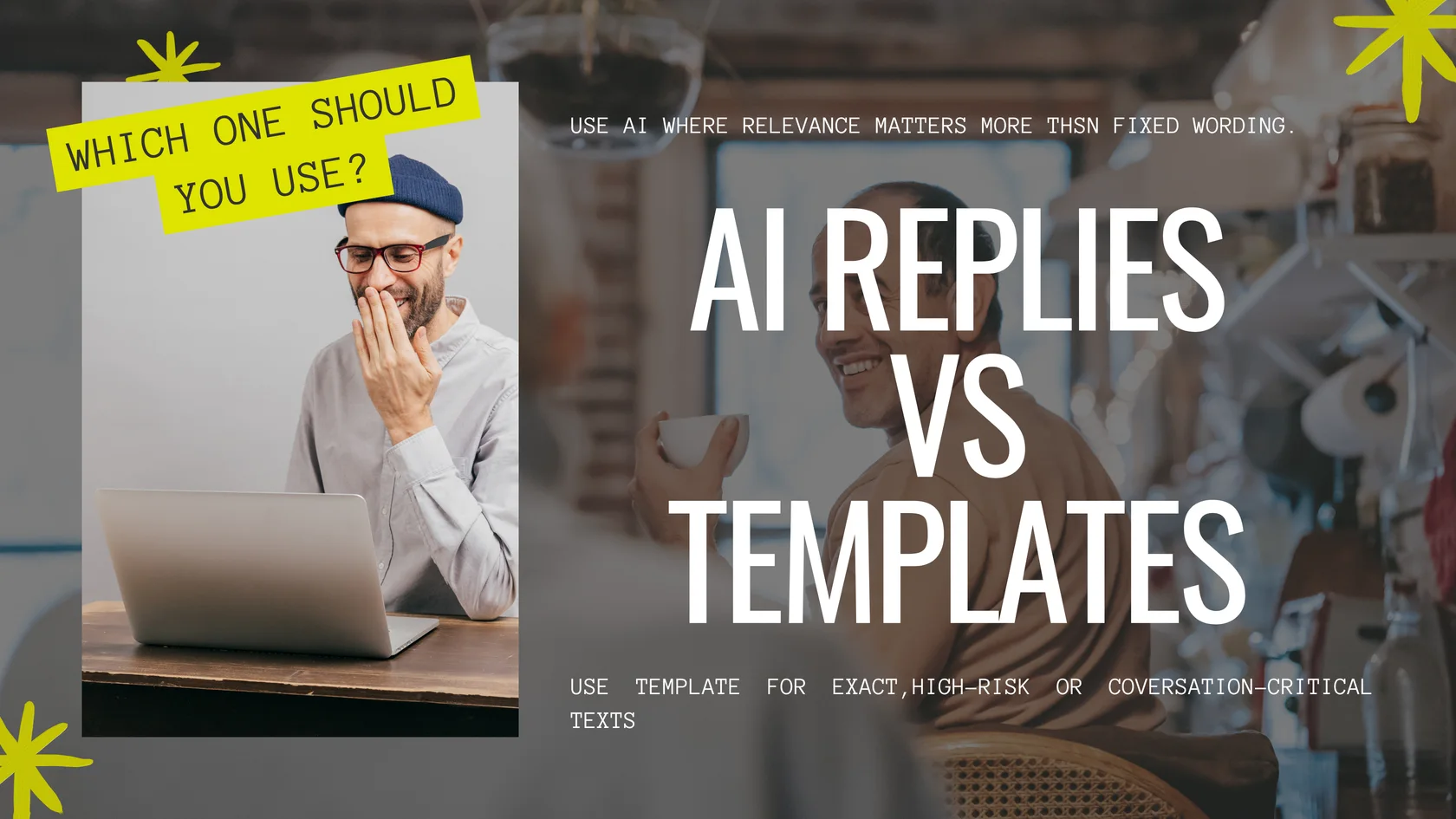

AI Replies vs Templates for Instagram: Which Should You Use?
Compare AI replies and Instagram DM templates with side-by-side examples, safety boundaries, use cases, and a practical weekly quality-review checklist.
Templates win when the answer should stay exact
If the message contains a link, pricing range, event detail, delivery instruction, or policy note, templates are usually the better choice. They are reliable, quick to review, and easy to keep compliant.
Structured flows also make it easier to test different prompts and offers without adding response unpredictability.
AI helps when context matters
AI is more useful when the incoming message varies a lot and the goal is to keep the reply relevant without forcing every user through the same copy.
That makes it a strong fit for nuanced comment replies, warm DM handling, and open-ended questions where a rigid script would feel awkward.

Build guardrails before you scale AI
AI should not guess about offers, availability, or sensitive account details. Give it strict boundaries around tone, approved claims, escalation moments, and when to fall back to a human or template path.
The best systems use AI inside a controlled framework, not as a free-form replacement for every message.
- Protect factual or legal messaging with templates
- Escalate edge cases instead of improvising
- Review transcripts regularly for drift
Most teams need a hybrid system
In practice, most good Instagram automation setups use both. Templates cover exact messages and important next steps. AI helps with open questions where a fixed reply would feel unnatural.
That mix gives you consistency where it matters and flexibility where it helps.
Review replies with a small quality sample
The choice between AI and templates is not permanent. Sample a handful of real conversations every week and look for clarity, accuracy, tone, and whether the response moved the person forward. This gives you evidence for which answers should become fixed templates and which still benefit from flexible language.
Keep a short list of approved facts, links, and phrases that AI should use. When the source information changes, update that list before changing the prompt. Reliable inputs are the foundation of reliable replies.
- Check a mix of short questions, unusual questions, and handoffs
- Turn repeated successful AI answers into reviewed templates
- Remove outdated product details from the source material as soon as they change
Compare the same customer question side by side
Suppose someone asks, ‘Does this work for a small skincare store?’ A template can give a consistent answer: ‘Yes. You can send product details from comments and route support questions to your team.’ An AI reply can use approved context to address the store type and ask which workflow matters most. Both can be useful, but they solve different parts of the exchange.
Judge replies on factual accuracy, relevance, clarity, tone, and next-step quality. Do not prefer an AI answer merely because it is longer or more personal. A two-sentence template is better when it answers the question safely and completely.
- Template strength: predictable wording, links, terms, and policy statements
- AI strength: adapting approved information to varied questions
- Human strength: judgment, exceptions, emotion, and high-value decisions
Use templates for exact and high-risk information
Keep prices, refund conditions, delivery promises, legal wording, account security guidance, and promotion deadlines in reviewed templates or controlled data fields. These answers should not change because a question is phrased differently. Assign an owner and review date to each business-critical message.
Templates still need context. Name what the link contains, explain the next step, and provide a route for questions. A bare URL may be technically correct but creates more uncertainty than a short explanation with the same destination.
- Lock claims that affect money, eligibility, safety, or customer expectations
- Keep one approved source for current prices, dates, and policy language
- Retire old templates when an offer or process changes
Use AI for variation inside clear boundaries
AI is most useful when many messages express the same underlying need in different language. Give the system approved product facts, audience context, tone guidance, and explicit limits. Tell it when to ask a clarifying question and when to hand the conversation to a person.
Avoid asking AI to infer sensitive traits, invent availability, promise outcomes, or resolve cases that require account access. The fallback response should be useful: acknowledge the question, explain that a person needs to review it, and set a realistic expectation for follow-up.
- Allow flexible phrasing around reviewed facts
- Block unsupported claims and requests for unnecessary personal information
- Escalate uncertainty instead of filling gaps with a confident guess
Run a weekly quality-review checklist
Review a representative sample rather than only the most successful conversations. Include common questions, low-confidence replies, complaints, handoffs, and conversations that ended immediately. Record the issue and the change required: source update, prompt rule, template, routing adjustment, or team training.
Check whether the reply answered the actual question, used only approved facts, sounded appropriate for the brand, respected consent and privacy, and offered a sensible next step. Trends matter more than one unusual message, so compare the same measures over time.
- Accuracy: every factual claim can be traced to an approved source
- Relevance: the response addresses the message instead of reciting general copy
- Safety: sensitive or uncertain cases reach a human
- Outcome: the person receives a useful answer or clear next step
Key takeaways
- Use templates for exact, high-risk, or conversion-critical messages.
- Use AI where relevance matters more than fixed wording.
- Using templates and AI together is often the easiest long-term setup.
Quick answers
Frequently asked questions
What should you know about “Templates win when the answer should stay exact”?
If the message contains a link, pricing range, event detail, delivery instruction, or policy note, templates are usually the better choice. They are reliable, quick to review, and easy to keep compliant. Structured flows also make it easier to test different prompts and offers without adding response unpredictability.
What should you know about “AI helps when context matters”?
AI is more useful when the incoming message varies a lot and the goal is to keep the reply relevant without forcing every user through the same copy. That makes it a strong fit for nuanced comment replies, warm DM handling, and open-ended questions where a rigid script would feel awkward.
What should you know about “Build guardrails before you scale AI”?
AI should not guess about offers, availability, or sensitive account details. Give it strict boundaries around tone, approved claims, escalation moments, and when to fall back to a human or template path. The best systems use AI inside a controlled framework, not as a free-form replacement for every message.
What should you know about “Most teams need a hybrid system”?
In practice, most good Instagram automation setups use both. Templates cover exact messages and important next steps. AI helps with open questions where a fixed reply would feel unnatural. That mix gives you consistency where it matters and flexibility where it helps.
What should you know about “Review replies with a small quality sample”?
The choice between AI and templates is not permanent. Sample a handful of real conversations every week and look for clarity, accuracy, tone, and whether the response moved the person forward. This gives you evidence for which answers should become fixed templates and which still benefit from flexible language. Keep a short list of approved facts, links, and phrases that AI should use. When the source information changes, update that list before changing the prompt. Reliable inputs are the foundation of reliable replies.
Put this guide into practice
Build a faster Instagram conversation workflow with Flozari.
Start automating with FlozariContinue reading
More Instagram automation guides

5–6 min read
10,000 Conversations. One Person. Impossible? Not Anymore.
Read article
4 min read
Built to Convert Conversations into Customers
Read article
5 min read